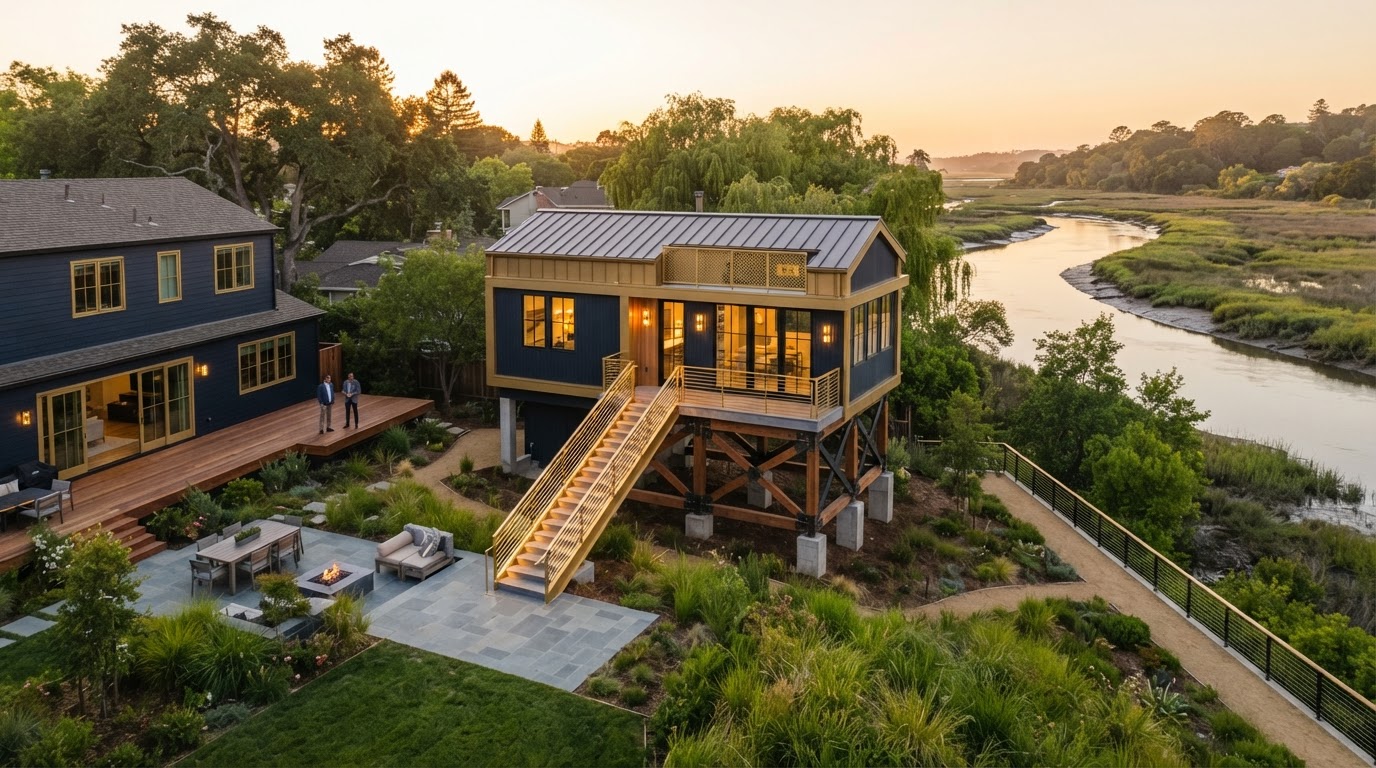
Can I Build an ADU in a Floodplain in Richmond VA?
Potentially, but floodplain conditions can add substantial site, design, and regulatory considerations. Whether an ADU is feasible may depend on the flood-zone or floodplain status, the jurisdiction, the proposed building location, the elevation, the foundation strategy, the utilities, the access, the applicable floodplain requirements, and the site conditions.
We do not provide official flood-zone determinations. The right first step is a property-specific review of the available floodplain information and the proposed ADU before assuming the property cannot support the project.
Do Not Assume the Entire Property Has the Same Floodplain Constraints
A property near a waterway or in a low-lying area is not necessarily uniformly constrained. The property mapping, the potential ADU location, the existing main home, the topography, the low areas, the drainage, the waterways, and the existing structures all affect whether a specific building site on the lot is affected by floodplain considerations.
One part of a lot may sit within a mapped floodplain while another part does not, and the proposed ADU's location matters as much as the property's general proximity to water. A property-specific review is needed before making assumptions about whether the proposed ADU location is affected.
We do not provide official flood-zone determinations. Available floodplain information is reviewed alongside the proposed project, and official determinations and requirements are confirmed with the applicable jurisdiction and floodplain administrator.
Property Mapping
Available floodplain mapping is reviewed alongside the property to understand which areas may be affected.
Potential ADU Location
The proposed ADU location is checked against the floodplain information, since one part of a lot may differ from another.
Existing Main Home
The main home's location and elevation provide context for how an ADU relates to the site.
Topography & Low Areas
Low areas and drainage paths are reviewed, since they can affect both flood risk and ADU placement.
Drainage & Waterways
Existing drainage and nearby waterways are considered as part of the site review.
Existing Structures
Existing structures and their elevations help frame what is already built on the property.
Foundation, Elevation and Utilities May Require Additional Planning
When a proposed ADU location is affected by floodplain conditions, the design may need to account for foundation strategy, finished-floor elevation, utility placement, equipment placement, site access, drainage, material selection, and construction sequencing. The factors below are reviewed at a high level for the specific property, and no specific elevated foundation type or floodproofing requirement is prescribed.
Foundation Strategy
The foundation approach is coordinated with the floodplain conditions, since a flood-prone site can call for a different foundation than a standard lot. The appropriate strategy is reviewed for the specific property rather than assumed.
Finished-Floor Elevation
Finished-floor elevation considerations can be central to a floodplain ADU, and the applicable elevation requirements are confirmed with the jurisdiction rather than assumed.
Utility Placement
Utilities—electrical, water, sewer, and mechanical—may need to be placed or elevated differently on a flood-prone site, and the placement is coordinated with the floodplain strategy.
Equipment Placement
Mechanical and electrical equipment placement is reviewed for flood risk, since equipment located low on the site can be vulnerable in a flood-prone area.
Site Access & Drainage
Access to the ADU and the site's drainage are reviewed together, since flood-prone conditions can affect both how the building is reached and how water moves around it.
Material Selection & Sequencing
Where applicable, material selection and construction sequencing are considered for floodplain conditions, though no specific floodproofing requirements are prescribed without jurisdictional confirmation.
Review the Site Before Assuming the Property Cannot Support an ADU
A floodplain ADU review works from the available floodplain information outward to the proposed project. The goal is to understand whether the proposed location is affected and what additional planning may be needed before assuming the property cannot support an ADU. The process below is adapted to the specific property and jurisdiction.
Confirm Property & Jurisdiction
The property and its jurisdiction are confirmed first, since floodplain and permitting requirements can differ across Greater Richmond.
Review Available Floodplain Information
Available floodplain information is reviewed alongside the property. We do not provide official flood-zone determinations; official status is confirmed with the applicable jurisdiction.
Identify Potential ADU Location
The proposed ADU location is identified and checked against the floodplain information, since one part of a lot may be affected while another is not.
Define Proposed Project
The proposed ADU type, size, and use are defined so the review reflects the actual project rather than a generic assumption.
Identify Additional Requirements
Additional site and design requirements—elevation, foundation, utilities, access—are identified for the proposed location and floodplain status.
Coordinate Technical / Professional Review
Where needed, applicable technical or professional review is coordinated. No floodplain approval is guaranteed, and official determinations remain with the jurisdiction.
Review Zoning & Permit Path
Applicable zoning and the permit path are reviewed for the jurisdiction, with project-specific questions confirmed with the applicable jurisdiction.
Determine Feasible Design Direction
A feasible design direction is determined for the specific property, ready to move into plans and permitting where the site supports the project.
Frequently Asked Questions About ADUs in a Floodplain
Direct answers about elevation, garage apartments, foundation design, utility placement, and jurisdiction differences.
Review the Site Before Assuming the Property Cannot Support an ADU
If your property is in or near a mapped floodplain and you are wondering whether an ADU is still possible, the right first step is a property-specific review of the available floodplain information and the proposed ADU. Foundation, elevation, utilities, and applicable floodplain requirements are considered before assuming the property cannot support the project.
Share your Richmond-area address and tell us about the site and the ADU you have in mind. We can help you understand what may be involved and what the next step is. Call 804-409-0928 to start.
Request an ADU & Suite Review
Let our specialists analyze your lot setbacks, existing structures, and local jurisdiction rules across Greater Richmond.