Can I Build an ADU on a Septic Property in Richmond VA?
Potentially. A septic property does not automatically rule out an ADU, but wastewater feasibility should be considered early. Whether the property can support an ADU may depend on the existing system, the proposed ADU use, the bedroom configuration, the property conditions, the system location, the site layout, and the applicable health or jurisdictional review.
No septic capacity or approval is guaranteed. The right first step is a property-specific review of the existing wastewater system and the proposed ADU before assuming the site can support the project.
Wastewater Can Affect Both ADU Design and Property Layout
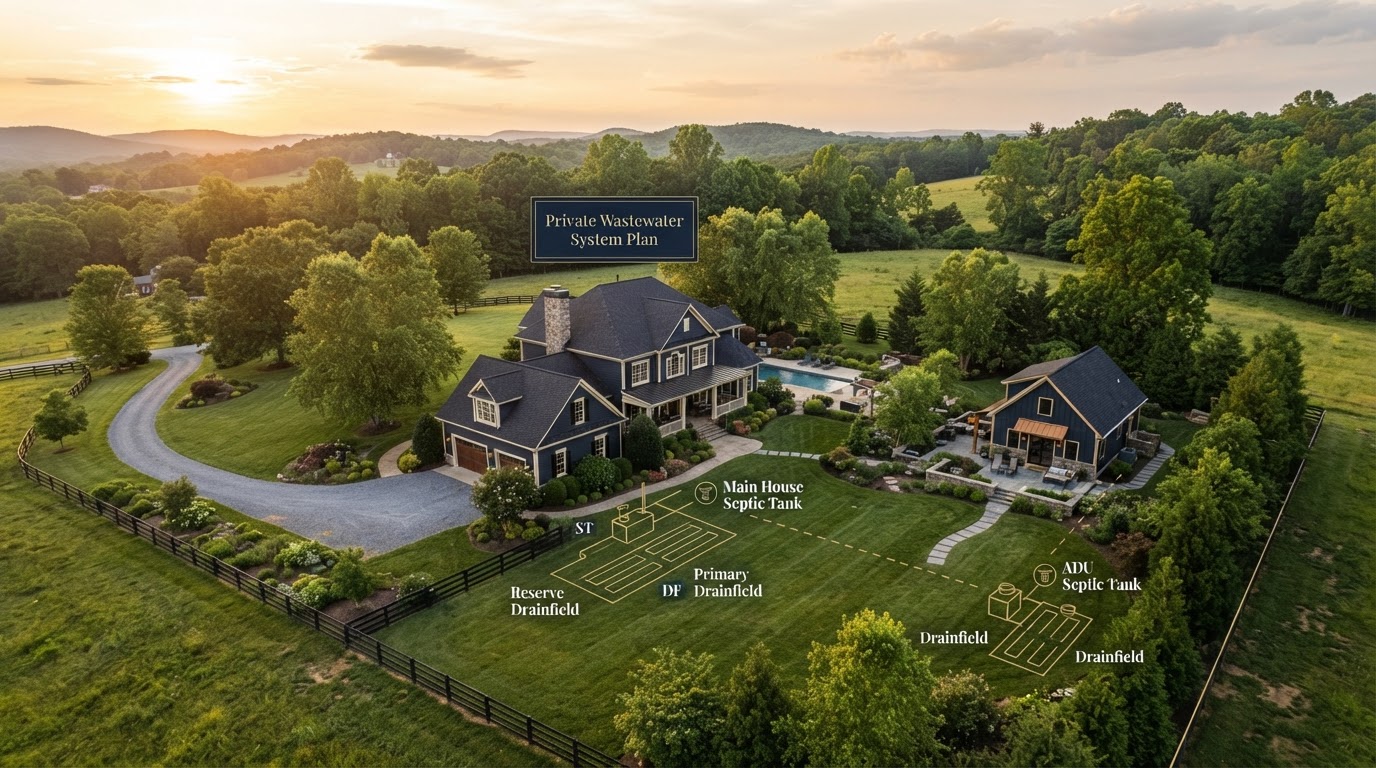
On a property served by a private septic system, wastewater is not just a utility connection—it is a feasibility question that can shape both the ADU design and the property layout. The existing home, the existing system, the proposed ADU, the bedrooms, the kitchen and bath, the occupancy and use, the system location, the available site area, and any potential future system needs all interact.
Bedroom count and fixture count are common factors in wastewater planning, since more bedrooms and fixtures generally mean higher demand. But the relationship between bedroom count and system capacity is reviewed for the specific property and applicable requirements rather than assumed from a formula.
Because wastewater capacity can affect whether an ADU is feasible at all, it is considered early—alongside zoning, access, and utilities—rather than discovered after the design is fixed. No septic capacity or approval is promised.
Existing Home
The main home's existing wastewater demand is the baseline against which the ADU's added demand is considered.
Existing System
The existing septic system's type, age, and design affect whether it can serve added living space.
Proposed ADU Use
How the ADU will be used—full-time, occasional, or family—shapes the wastewater demand that is planned for.
Bedrooms & Fixtures
Bedroom count and kitchen and bath fixtures are common factors in wastewater capacity planning.
System Location
Where the existing system and drainfield sit can affect where the ADU can and cannot be placed.
Future System Needs
Reserve or replacement area considerations, where applicable, can also constrain ADU placement.
Building Placement and Wastewater Planning Need to Work Together
On a septic property, the ADU's placement and the wastewater system are connected. The existing system location, the drainfield or system area, and any future replacement or reserve considerations can all constrain where an ADU can go. The factors below are reviewed at a high level for the specific property, and no septic capacity or approval is guaranteed.
Existing System Location
The existing septic system and drainfield location are reviewed alongside the proposed ADU placement, since building over or near an active system can be restricted. The relationship is reviewed for the specific property rather than assumed.
Drainfield / System Area
The drainfield or system area occupies space on the lot, and that space is coordinated with the ADU footprint, driveway, and yard rather than treated as unrelated.
Reserve / Replacement Area
Where applicable, a future replacement or reserve area may need to be protected, which can further constrain where an ADU can be placed. Reserve considerations are reviewed for the specific property.
Driveway & Garage
The driveway, garage, and existing outbuildings all compete for the same lot space as the septic area and the ADU, so they are reviewed together as one site plan.
Utilities & Topography
Utility routes and topography can interact with the septic area, since a gravity wastewater path or a trench route may need to avoid the system. These are coordinated for the specific property.
Construction Access & Foundation
Construction access and the ADU foundation are reviewed so that site work does not damage the existing system and the building is placed on a suitable part of the lot.
Review the Wastewater System Before Finalizing the ADU
A septic-property ADU review works from the wastewater system outward. The goal is to understand the existing system, the proposed use, and the site relationships before deciding whether the property can support the ADU and where it should go. The process below is adapted to the specific property and jurisdiction.
Confirm Wastewater Type
The first step is confirming the property is on a private septic system rather than public sewer, since the feasibility path differs.
Gather Available Information
Available septic and property information—system type, age, location, and any records—is gathered to understand the starting point.
Define Proposed ADU Use
The proposed ADU use, bedroom count, and fixtures are defined so the wastewater demand can be considered at a planning level.
Review Property Layout
The property layout—existing system, drainfield, reserve area, driveway, and yard—is reviewed for where an ADU could and could not go.
Identify Capacity & Location Questions
Wastewater capacity and placement questions are identified, including whether the existing system may serve the ADU or whether additional review is needed.
Determine Additional Review Needs
Where needed, qualified septic, soil, or jurisdictional review is coordinated. We do not perform regulated septic engineering unless verified, and capacity is not assumed.
Refine ADU Design & Placement
The ADU design and placement are refined around the wastewater strategy so the building and the system work together on the lot.
Frequently Asked Questions About Building an ADU on Septic
Direct answers about septic upgrades, shared systems, bedroom count, separate systems, and county differences.
Review the Wastewater System Before Finalizing the ADU
If your property is on a private septic system and you are wondering whether an ADU is possible, the right first step is a property-specific review of the existing system and the proposed use. Wastewater capacity, system location, and site layout are considered before any assumption is made about what the property can support.
Share your Richmond-area address and tell us about the existing system and the ADU you have in mind. We can help you understand what may be involved and what the next step is. Call 804-409-0928 to start.
Request an ADU & Suite Review
Let our specialists analyze your lot setbacks, existing structures, and local jurisdiction rules across Greater Richmond.