ADU Financing Options Virginia
How do homeowners fund an ADU in Virginia? Homeowners may explore several financing categories depending on project scope, home equity, credit profile, and lender requirements. Financing products change, so actual terms should be reviewed with qualified lenders.
This page is educational only. Richmond VA ADU & In-Law Suite does not provide financing, act as a lender, act as a mortgage broker, or maintain preferred lender relationships. Our role is the ADU feasibility, design, and construction side of the project. Here are the common funding categories and what lenders typically need.
Common ADU Funding Categories
ADU projects are residential construction, and homeowners typically fund them through the same categories used for major home improvements. The right category depends on the project scope, the homeowner's equity, credit profile, and the lender's requirements.
Cash or savings avoids debt but ties up funds. Home equity products—a line of credit or a loan—use the existing home's equity. Cash-out refinance replaces the existing mortgage. Construction loans and construction-to-permanent financing are designed for building projects. Renovation-oriented loan products may also be available.
No interest rates or lender recommendations are provided here. Financing products change, and actual terms depend on the lender, the property, and the borrower. Terms are confirmed with qualified lenders.
Cash or Savings
Funds the project without debt but ties up cash that might be used elsewhere.
Home Equity Line of Credit
A HELOC draws on the existing home's equity, typically with a draw period and repayment terms set by the lender.
Home Equity Loan
A lump-sum loan secured by the existing home's equity, with terms set by the lender.
Cash-Out Refinance
Replaces the existing mortgage with a new, larger loan and provides the difference as cash for the project.
Construction Loan
A short-term loan designed for building projects, typically with terms tied to construction milestones.
Construction-to-Permanent
Converts from a construction loan to a permanent mortgage after construction, where available.
Lenders May Need a Defined Project
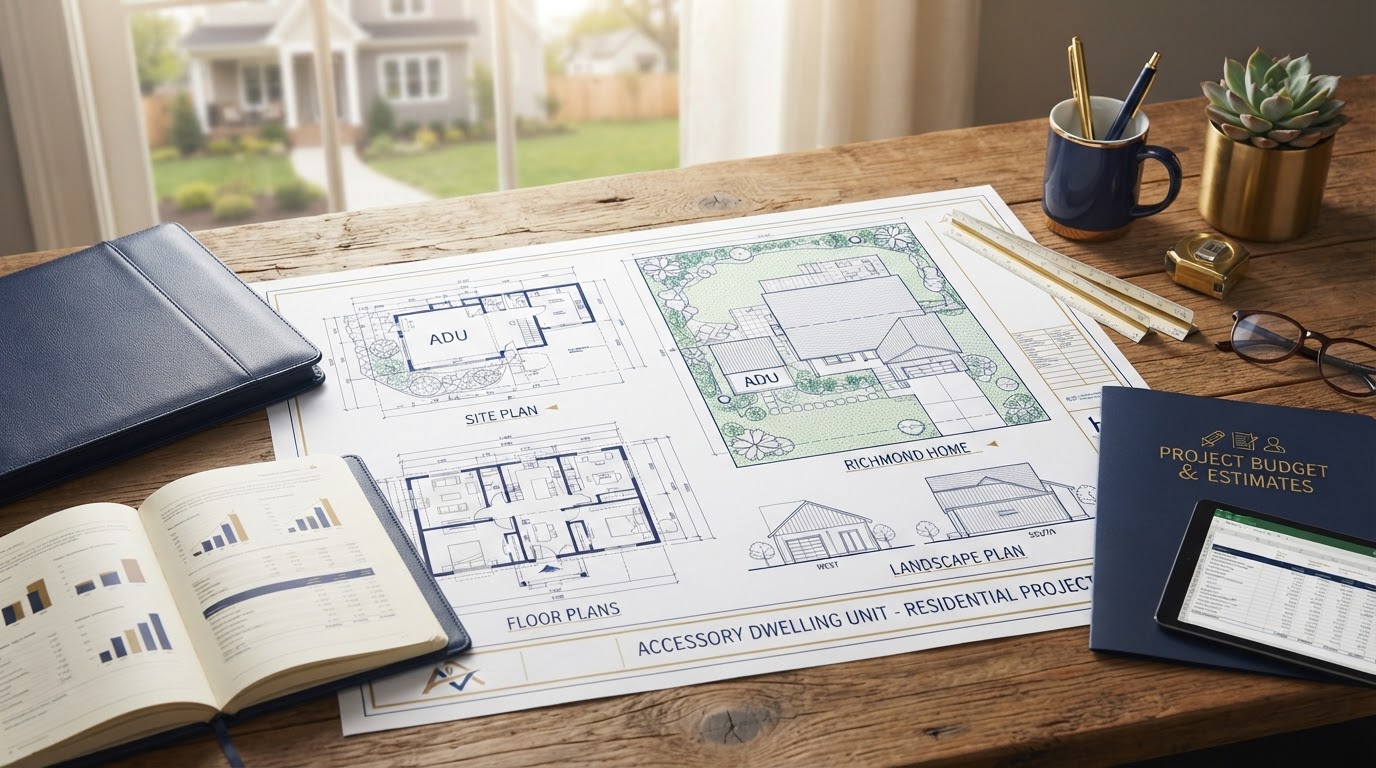
Lenders typically evaluate a financing request against a defined project—not a vague idea. The more concrete the project, the more clearly a lender can assess it. This is why feasibility and a preliminary scope often come before finalizing financing.
Plans + Scope
Lenders commonly need plans and a defined scope—what is being built, how large, and what systems are included—so the project is concrete enough to evaluate.
Budget
A project-specific budget helps the lender understand the financing need. A property-specific ADU review produces a more useful budget than a generic range.
Property Information
Lenders need property information—the address, existing structures, and site conditions—to assess the collateral and the project.
Contractor Information
Construction loans and similar products often require contractor information and construction documentation as part of the evaluation.
Construction Documentation
Draw schedules, construction milestones, and documentation may be required, particularly for construction loans tied to project phases.
Appraisal Where Required
Some loan products require an appraisal. How an ADU is appraised can differ from the main house and depends on the appraiser and the market.
Define the Project Before Finalizing Financing
Because lenders need a defined project, the most useful sequence is to define the ADU scope before finalizing financing. This process keeps feasibility and scope ahead of the financing conversation. No financial advice is provided.
Determine ADU Type
Determine the ADU type—detached, attached, garage conversion, garage apartment, or basement—because each carries a different scope and budget.
Review Property Feasibility
Review the property, existing structures, and utilities to confirm the ADU is feasible before pursuing financing.
Develop Preliminary Scope
Develop a preliminary scope—size, systems, kitchen and bath, and finish level—so the project is concrete enough for a lender to evaluate.
Understand Major Cost Drivers
Understand the major cost drivers—site, foundation, utilities, and interior scope—so the budget reflects the real project.
Speak With Qualified Lenders
Speak with qualified lenders about the financing categories that fit the project and the borrower's profile. Terms are confirmed with the lender.
Refine Design + Budget
Refine the design and budget based on the lender's requirements, including any appraisal or construction documentation needed.
Coordinate Documentation
Coordinate the plans, scope, budget, and contractor information the lender needs to evaluate the request.
Proceed Through Appropriate Approvals
Proceed through the lender's appropriate approvals. Richmond VA ADU & In-Law Suite does not provide or guarantee financing.
Frequently Asked Questions About ADU Financing Options
Educational answers—no financing provided, no interest rates, no lender recommendations.
Define Your ADU Project Scope
Financing an ADU starts with a defined project. Lenders need plans, scope, a budget, and property information to evaluate a request—so feasibility and a preliminary scope usually come before finalizing financing. We do not provide financing; we help define the project a lender can evaluate.
Share your property and your goals, and we can develop a scope that gives a lender something concrete to review. Call 804-409-0928 to start.
Request an ADU & Suite Review
Let our specialists analyze your lot setbacks, existing structures, and local jurisdiction rules across Greater Richmond.